

War and weather impact on coffee production

Every summer, the Sahara Dust drifts across Jamaica’s skyline, affecting this luxury coffee-growing island, already vulnerable to violent weather.

For locals, the sight of the dust reinforces that summer is here! Remember, all weather involves the transfer of heat. If desert dust is visible, what about the thousands of missiles fired in recent years across the Middle East, Eastern Europe, and parts of Africa?

One missile can destroy an entire apartment complex and some can destroy entire blocks. Could they be contributing to atmospheric heating? The heat and carbon emissions from these missile strikes might be making their way toward the Caribbean. While no scientific evidence supports this theory yet, it does raise interesting questions.

The Jamaican coffee industry is facing growing challenges due to increasingly unpredictable weather patterns, including heavier rainfall and prolonged droughts. Recently, the industry reported losses of US$3.5 million—over 15% of its annual crop. Experts point to intensified heat transfer in the atmosphere, potentially worsened by global conflicts, as a contributing factor. This is driving up global coffee prices, mirroring the impacts already felt in Jamaica’s Blue Mountain Coffee sector.

On Monday, Nasdaq reported that coffee commodity prices—both Arabica and Robusta—rose by 1.9% and 1.6%, respectively, for October 28. This rally is largely attributed to weather disruptions affecting major coffee-growing regions. Extreme conditions, such as excessive rain and prolonged droughts, are hampering harvests. Brazil, the world’s largest coffee producer, is grappling with inconsistent weather, driving prices higher. Similarly, reports from Colombia highlight concerns over unstable growing conditions.

Why Starbucks in Jamaica Doesn’t Sell Jamaican Coffee

Years after Starbucks recommitted itself to incorporate Jamaican coffee into its local offerings, the reality tells a different story.

Walk into any Starbucks store in Jamaica today, and one thing is constant: it does not sell Jamaican coffee. This contradicts the very intention of its entry into the market back in 2017 and its recommitment to offer local beans in 2020.

At the time of Starbucks’ expansion into Jamaica, the company expressed excitement about using local Blue Mountain and High Mountain coffee varieties. As local franchise holder and businessman Ian Dear noted, “Starbucks has proudly sourced Jamaican Blue Mountain coffee since the early days of its operations…and it continues to be a key feature in the Starbucks Reserve line of small-lot coffees in the U.S. and select international markets”.

When Starbucks first entered Jamaica, it briefly offered local coffee during its first year, albeit at prices nearly double those of supermarket brands. The challenge, however, lay in sourcing quality beans at a competitive price.

Compounding the problem, all the beans were shipped to Seattle for roasting and bagging, only to be shipped back to Jamaica. This process made local coffee prohibitively expensive for the Jamaican market.

Despite the initial excitement, none of the Starbucks locations in Jamaica currently offer Jamaican-grown coffee. This missed opportunity has been a disappointment for the local coffee industry, which had hoped that Starbucks’ presence would lead to increased international exposure and local job creation. Instead, Jamaican farmers and stakeholders are left questioning the unfulfilled promises, as Starbucks continues to rely on imported coffee, leaving its local varieties absent from the menu. The goal of supporting the Jamaican economy and promoting its world-renowned coffee remains unrealized.

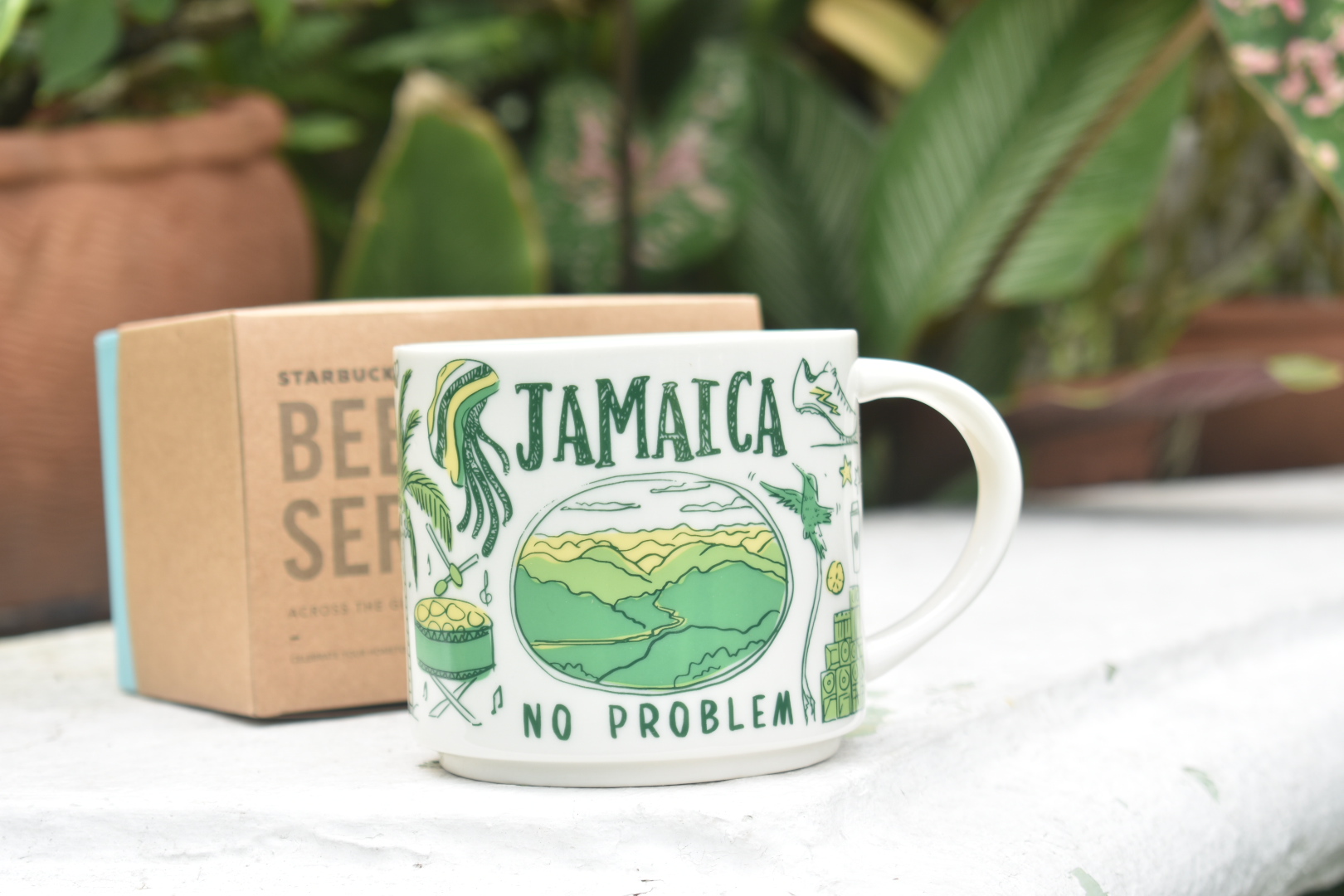
The only thing Jamaica based is its Been There Travel mugs.

The rarest Starbucks Been There Mugs

Starbucks “Been There” mugs have become a favorite souvenir, especially for those who collect travel memorabilia. Interestingly, these mugs are not just meaningful for those who have visited the country—they can also be a way to connect with a place you’ve yet to explore. For collectors, the rarer the location, the more coveted the mug becomes. The rarest “Been There” mugs often come from Starbucks’ newest markets, making them highly sought after.

Based on the most recent expansions, the rarest mugs would be from the latest countries Starbucks has entered. As of 2023 and 2024, Starbucks has expanded into countries like Cambodia, Laos, Guyana, and others, bringing their store count to over 86 markets worldwide. The newest Starbucks locations include:

  1. Guyana
  2. Laos
  3. Cambodia
  4. Panama
  5. Jamaica + Barbados
  6. Papua New Guinea
  7. Angola
  8. Uzbekistan
  9. Kazakhstan
  10. Malta

This ranking reflects the rarity of the mugs, with the most recent market, Guyana, offering the rarest collectible mug. As Starbucks continues to expand globally, these mugs will remain a great way to experience the world—whether you’ve been there or not.

No Problem Mugs 14oz Buy Here

AI for coffee blends. Sounds like gimmicks

An artisan roastery based in the Finnish capital has introduced a coffee blend that has been developed by artificial intelligence, in a trial in which it’s hoped that technology can ease the workload in a sector that traditionally prides itself on manual work, according to an AP article.

It is only apt that the Helsinki-based Kaffa Roastery’s ‘AI-conic’ blend was launched this week in Finland, a Nordic nation of 5.6 million that consumes the most coffee in the world, at 12 kilogrammes per capita annually, according to the International Coffee Organisation.

The blend – an AI-picked mixture with four types of beans dominated by Brazil’s velvety Fazenda Pinhal – is the end result of a joint project by Kaffa, Finland’s third-biggest coffee roastery, and local AI consultancy Elev.

“Leveraging models akin to ChatGPT and Copilot, the AI was tasked with crafting a blend that would ideally suit coffee enthusiasts’ tastes, pushing the boundaries of conventional flavour combinations,” Elev said.

Kaffa Roastery’s managing director and founder Svante Hampf told The Associated Press on Saturday that the two partners wanted to trial how AI and its different tools could be of help in coffee roasting, a traditional artisan profession highly valued in Finland.

“We basically gave descriptions of all our coffee types and their flavours to AI and instructed it to create a new exciting blend,” said Hampf, while showcasing ‘AI-conic’ at the Helsinki Coffee Festival that annually brings together roasteries and coffee aficionados.

In addition to coming up with its chosen mixture of beans from Brazil, Colombia, Ethiopia and Guatemala, AI created the coffee package label and a detailed taste description, saying ‘AI-conic’ is “a well-balanced blend of sweetness and ripe fruit”.

Hampf acknowledged he was surprised that AI “somewhat weirdly” chose to make the blend out of four different type of coffee beans, rather than the usual two or three which allows distinction in taste between flavours from different origins.

After the first test roasting and blind testing, Kaffa’s coffee experts agreed, however, that the tech-assisted blend was perfect, and there was no need for human adjustments.

According to Elev’s spokesman Antti Merilehto, “AI-conic is a tangible example of how AI can introduce new perspectives to seasoned professionals” while offering coffee lovers new taste experiences.

Kaffa Roastery hopes the trial serves as an opener of dialogue between coffee professionals of things to come in the future in Finland, a nation that has both a strong coffee culture and a passion for technology with a flourishing start-up scene.

“This (trial) was the first step in seeing how AI could help us in the future,” Hampf said, adding the project brought smoothly together “the artisan skills of a roastery” and AI-provided data. “I think AI has plenty to offer us in the long run. We are particularly impressed of the coffee taste descriptions it created.”

– AP